
About one in five trials in two separate registry samples failed to complete (adult cancer trials) or ended with failed or inadequate accrual (phase 2 and 3 trials of all kinds). Tufts researchers have valued each day of delay in drug development at roughly $500,000 to $800,000 in lost prescription sales for the sponsor, depending on which of their 2024 reports is used, and the evidence we reviewed suggests that sites and patients bear costs of their own. No study we found attaches a dollar figure to a single missed patient, so this post does not invent one. It argues from the pooled evidence that the costs of slow enrollment at the sponsor, site and patient levels all begin at the same point: an eligible patient who was never identified.
Failed accrual is common across disease areas
The best-known estimate comes from an analysis of 7,776 phase II and III adult cancer trials initiated between 2005 and 2011, in which the seven-year cumulative incidence of failure to complete was approximately 20% (Stensland et al.). Cancer is not unusual in this respect. A registry analysis of 2,579 phase 2 and 3 intervention trials of all kinds that closed in 2011 found that 481 (19%) either terminated for failed accrual or completed with less than 85% of the expected enrollment (Carlisle et al.). Of 905 terminated trials in the ClinicalTrials.gov results database as of February 2013, 619 stopped for reasons other than data from the trial, and insufficient accrual was the leading reason among them (350 of 619) (Williams et al.).
These studies measure different things, and their samples are now a decade old or more. We did not locate a more recent cross-disease estimate that we could verify. Taken together, they place failed accrual among the most frequent reasons a trial does not produce an interpretable answer, in cancer and in other fields.
Delay is more common than failure, and it has a price
Trials that finish are often late. In the Tufts Center for the Study of Drug Development study of 151 phase II and III trials conducted between 2008 and 2010, covering nearly 16,000 sites, 47% of studies completed enrollment within the planned timeline, 53% had extended timelines, and one in six took more than twice as long as planned (Getz, 2012). In the same data, 11% of sites ready to begin recruitment enrolled no patient, and 41% of activated sites fell short of their enrollment target. A 2024 update comparing benchmarks from 2012, 2019 and 2023 reports a more favorable picture, in which actual enrollments exceeded planned enrollments for a majority of studies and timelines were shorter than expected (Lamberti et al.). We could read only the abstract of that update, so we do not cite its percentages. The improvement it describes is also uneven, since it found differences by global region and site type.
Tufts researchers have also revised the cost of delay, replacing a figure of $4 million to $5 million per day that dated from 1993 estimates. In a peer-reviewed 2024 analysis of sales data for 645 drugs and biologics launched since 2000 and 409 trial budgets, in 2023 US dollars, they estimated that a single day of delay is worth approximately $500,000 in lost prescription sales and that a phase II or III trial costs about $40,000 per day to run (Smith, DiMasi and Getz, 2024). A later Tufts white paper that cites the article, drawing on budgets from 447 protocols, gives approximately $800,000 per day in lost sales and $55,716 per day in direct costs for phase III, and does not explain the difference (Tufts CSDD white paper). Its sales figure is an average across each product’s selling days from launch, so it does not describe the cost of delay for any specific drug, and therapeutic areas differ (median daily sales were $1.4 million for cardiovascular products and $840,000 for oncology).
Sites absorb the cost differently
For a site, the cost of weak enrollment is less visible than the sponsor’s but arrives sooner. In the Society for Clinical Research Sites’ 2023 survey, 88% of sites said screen failures are not sufficiently covered by payments (SCRS); post 10 discusses the survey’s other budget findings. We could not verify the survey’s sample size or per-patient budget figures, and it is an industry survey rather than a peer-reviewed study. It nonetheless indicates that screening effort is often unpaid unless it ends in enrollment.
Estimates of non-enrolling sites vary with definition. Medidata’s analysis of more than 2,000 studies reported in 2012 that nearly one-third of sites never enroll a single patient (Medidata, 2012), whereas the Tufts figure above (11%) counts only sites that were ready to begin recruitment. On either definition, a meaningful share of activated sites enrolls no one, so the effort of activating them yields no enrollment.
Patients lose an option, which is different from losing a proven benefit
The patient-level cost needs careful statement. A structured review in The Lancet found 26 comparisons of cancer patients inside and outside trials and concluded that there were insufficient data to establish that trial participation itself improves outcomes, noting that control for confounding was inconsistent and frequently inadequate (Peppercorn et al.). We therefore do not claim that a patient who is not enrolled receives worse care. In our reading, the loss is the option to take part, which matters most to patients with few remaining treatment options and which cannot be exercised if the patient is never identified.
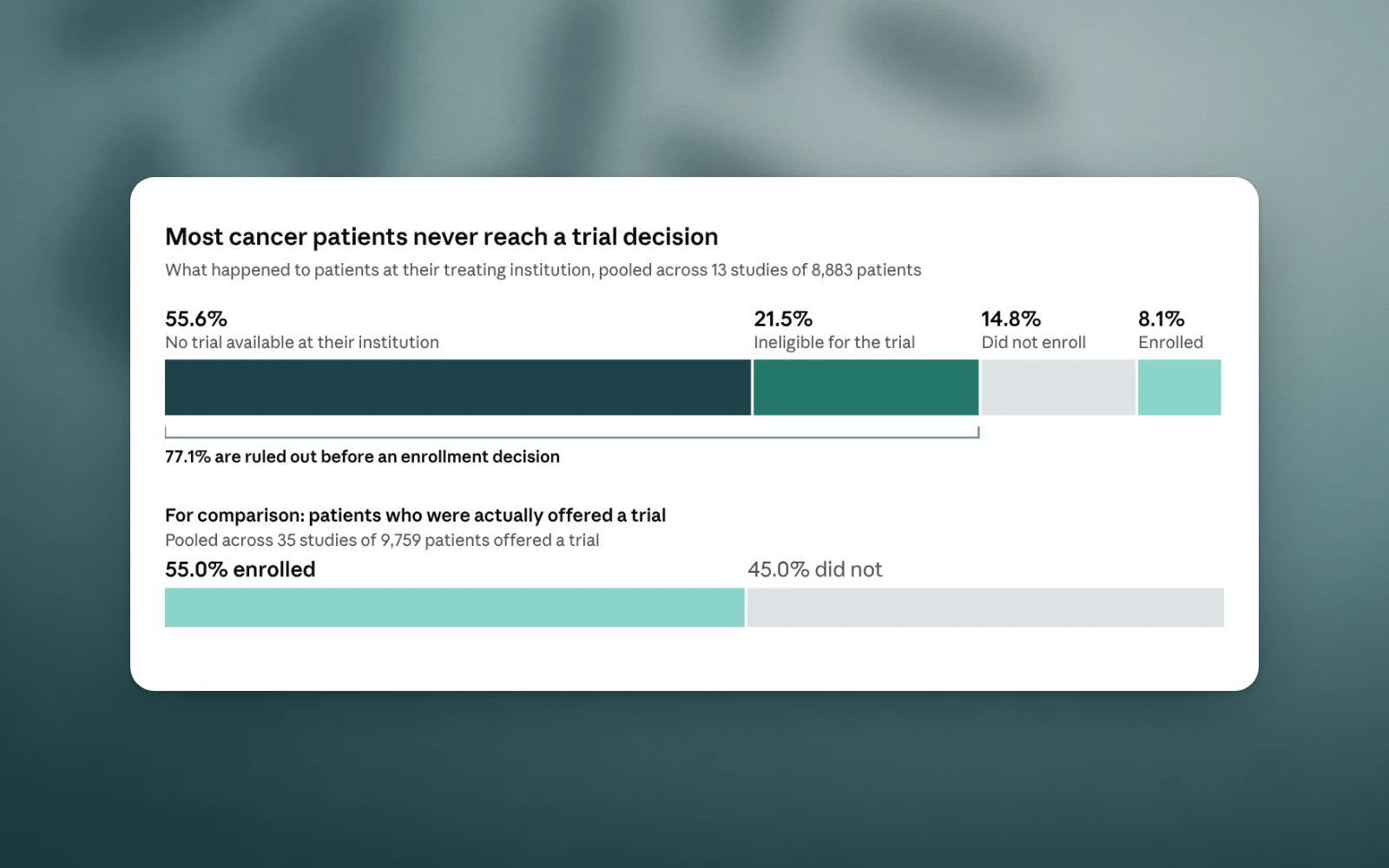
The pathway evidence shows how often that option fails to arise. In a meta-analysis of 8,883 cancer patients from 13 studies, a trial was unavailable at the patient’s institution 55.6% of the time, 21.5% of patients were ineligible for an available trial, 14.8% did not enroll and 8.1% enrolled (Unger et al.). Those figures are specific to oncology, and trial availability sits largely outside a site’s control. The remainder of the pathway is where screening occurs.
Patients also bear the consequences of failed trials. The trials making up Carlisle and colleagues’ 19% had enrolled 48,027 patients, in studies that were unable to answer their primary research question meaningfully (Carlisle et al.).
Where the three costs converge
An eligible patient who is not identified at the site shows up in all three accounts. For the sponsor, that patient is one fewer toward an accrual target, and insufficient accrual is the leading documented reason that trials stop for reasons other than trial data. For the site, the patient is enrollment that never happens, and surveyed sites report that screening effort that ends in a screen failure is often not sufficiently covered. For the patient, it is an option that was never offered.
These accounts rest on different studies, and we cannot add them into a total. They share a cause, however, that sites can influence. Where a site’s identification of eligible patients depends on manual chart review and the memory of busy staff (the first post in this series reviews that evidence for oncology), each patient who goes unrecognized is a loss that was avoidable at the point of identification.
What we are building
Centrova’s platform reviews the clinical notes and documents a site already holds and checks each patient against the inclusion and exclusion criteria of open trials. Coordinators and investigators review the candidates and make the final eligibility determination. The platform also includes patient tracking, communication and site coordination tools, and it works across disease areas and with multiple EHR systems. Testing is free during development; sites can contact us.
Sources
- Stensland KD, McBride RB, Latif A, et al. Adult cancer clinical trials that fail to complete: an epidemic? J Natl Cancer Inst. 2014;106(9):dju229. https://doi.org/10.1093/jnci/dju229
- Carlisle B, Kimmelman J, Ramsay T, MacKinnon N. Unsuccessful trial accrual and human subjects protections: an empirical analysis of recently closed trials. Clin Trials. 2015;12(1):77-83. https://doi.org/10.1177/1740774514558307
- Williams RJ, Tse T, DiPiazza K, Zarin DA. Terminated trials in the ClinicalTrials.gov results database: evaluation of availability of primary outcome data and reasons for termination. PLoS One. 2015;10(5):e0127242. https://doi.org/10.1371/journal.pone.0127242
- Getz K. Enrollment performance: weighing the “facts.” Applied Clinical Trials. 2012;21(5). May 1, 2012. https://www.appliedclinicaltrialsonline.com/view/enrollment-performance-weighing-facts
- Lamberti MJ, Dirks A, Kikuchi N, Patel Cervantes N, Getz K. Benchmarking site activation and patient enrollment. Ther Innov Regul Sci. 2024;58(4):696-703. https://doi.org/10.1007/s43441-024-00638-1
- Smith ZP, DiMasi JA, Getz KA. New estimates on the cost of a delay day in drug development. Ther Innov Regul Sci. 2024;58(5):855-862. https://doi.org/10.1007/s43441-024-00667-w
- Smith Z, DiMasi J, Getz K. Quantifying the value of a day of delay in drug development. Tufts Center for the Study of Drug Development white paper. 2024 (undated; file name gives August 2024). https://csdd.tufts.edu/sites/default/files/2025-02/Aug2024%20Day%20of%20Delay%20White%20Paper%20Final.pdf
- Society for Clinical Research Sites. SCRS Site Landscape Survey 2023: Site Finances Whitepaper. 2024. https://myscrs.org/wp-content/uploads/2024/08/Site-Finances-Whitepaper-2024.pdf
- Medidata Solutions. Non-enrolling and high-enrolling site data. Applied Clinical Trials. 2012;21(5). https://www.appliedclinicaltrialsonline.com/view/non-enrolling-and-high-enrolling-site-data
- Peppercorn JM, Weeks JC, Cook EF, Joffe S. Comparison of outcomes in cancer patients treated within and outside clinical trials: conceptual framework and structured review. Lancet. 2004;363(9405):263-270. https://doi.org/10.1016/S0140-6736(03)15383-4
- Unger JM, Vaidya R, Hershman DL, Minasian LM, Fleury ME. Systematic review and meta-analysis of the magnitude of structural, clinical, and physician and patient barriers to cancer clinical trial participation. J Natl Cancer Inst. 2019;111(3):245-255. https://doi.org/10.1093/jnci/djy221