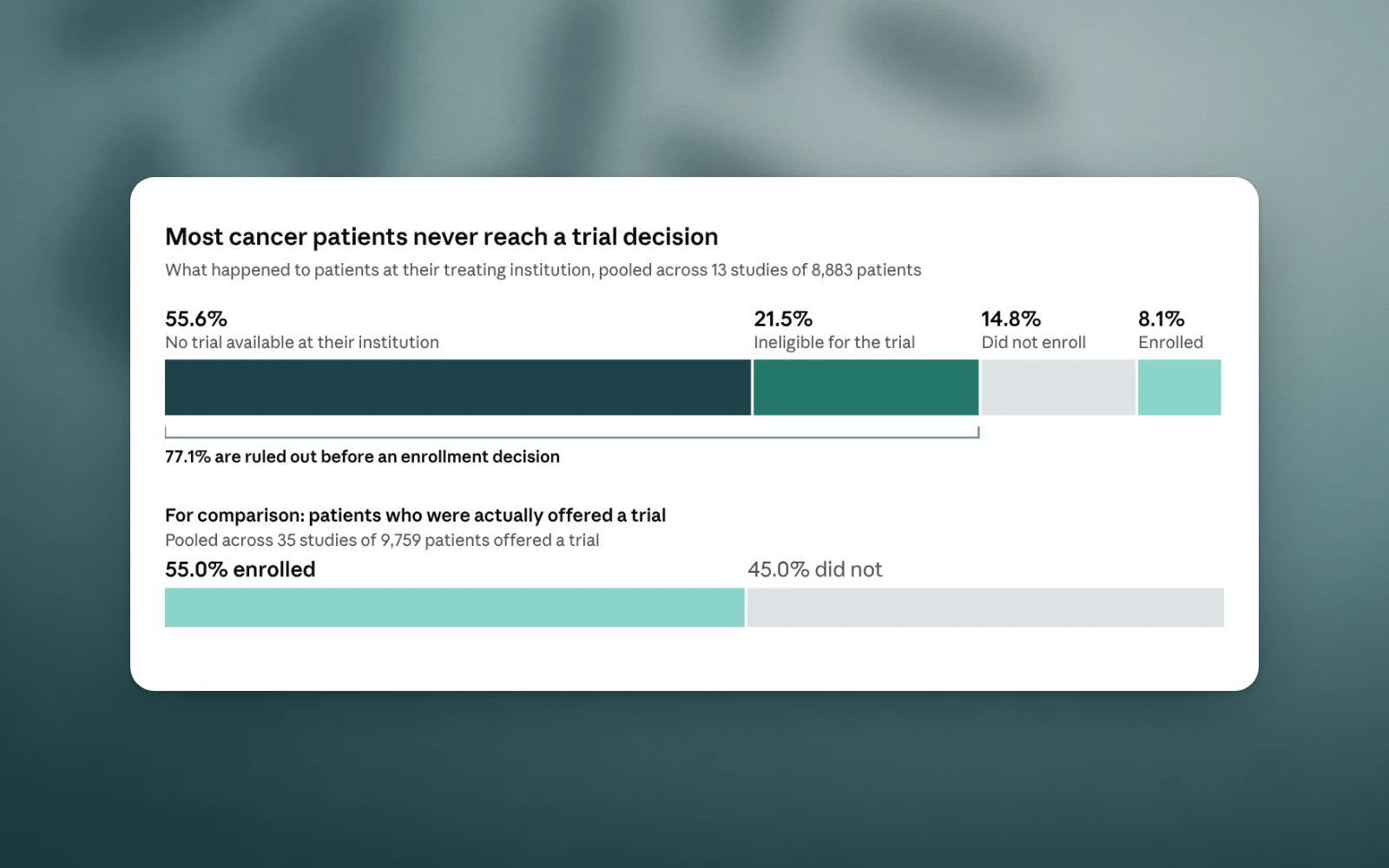

In the studies reviewed here, between 19% and 62% of the patients screened for a clinical trial were not enrolled, depending on the disease area and the design of the study, and Tufts benchmarks put average dropout from late-phase studies at 15% to 19%. These two losses occur after a site has already identified, approached and often consented a patient, so each one consumes coordinator time that produces no data. The published evidence supports a measured conclusion. Some screen failures arise from criteria that were discoverable in the record before the screening visit, and some dropout arises from communication and follow-up gaps that a site can manage. Other causes, including laboratory values that change between visits, imaging results and adverse events, lie beyond what any record review or software can prevent.
How large screen failure is across disease areas
Screen failure rates vary widely, and published figures are not directly comparable because trials define “screened” differently. In 50 phase II and III genitourinary cancer trials conducted between 1999 and 2016, only 24 reported screen failure rates; among phase III trials the mean was 26% in prostate cancer and 25% in kidney cancer, and 19% in phase II/III bladder cancer trials (Wong et al.). An audit of 15 randomized studies at one Indian cancer center, covering 7,481 patients screened, found that 51.0% screen failed (Parekh et al.).
Rates are higher in conditions that require confirmatory tests. A pooled analysis of 58 trials of drugs for metabolic dysfunction-associated steatohepatitis, covering 44,949 individuals, estimated a screen failure rate of 56.28% (95% CI 50.14 to 62.23), with rates rising over time and with the number of sites (Souza et al.). In the SYMPLICITY HTN-3 trial of renal denervation for resistant hypertension, 880 of 1,415 screened patients (62%) did not meet randomization criteria (Waksman et al.). In the two semaglutide trials in early Alzheimer’s disease, evoke and evoke+, 58.6% and 59.8% of screened participants failed, according to a conference abstract (Sano et al.).
Why patients fail screening
The leading reason in most analyses is ineligibility. In the Indian oncology audit, failure to meet inclusion criteria accounted for 54.9% of screen failures, followed by declining treatment (22.2%) and unwillingness to stay near the trial site (6.2%) (Parekh et al.). In the semaglutide trials the main reasons were cognitive test scores, followed by amyloid positivity, dementia rating and imaging findings, in the order of a hierarchical screening procedure (Sano et al.). In SYMPLICITY HTN-3, most failures involved blood pressure. They were most common at the first screening visit, where patients failed the office systolic entry criterion; at the second visit the predominant reason was an office reading below the threshold in patients who had met it at the first, and failures on ambulatory criteria were often due to white-coat hypertension (Waksman et al.).
These examples show two kinds of ineligibility. One kind rests on facts already in the chart, such as a diagnosis, a prior therapy, a medication or an earlier laboratory result. The other rests on a measurement that can only be taken at screening, such as a cognitive test, a PET scan or a repeated blood pressure reading. Only the first kind can be checked in advance.
What screen failure costs
Direct cost data are scarce in the peer-reviewed literature, and we did not find a rigorous per-patient estimate. What the literature does show is the scale of effort. In the POINT trial of minor stroke and transient ischemic attack, more than 27,000 patients were screened across 172 sites and 95% were not enrolled, and the authors argued that collecting screening data was itself burdensome and inconsistent across sites (Elm et al.). A sponsor-reported example in a trade publication described a 70% screen failure rate in earlier phase II trials of the same agent, and noted that a central laboratory test typically costs $230 to $675 (DuBois et al.). The authors of a 2026 single-institution prescreening report estimated the cost of one formal screening at £2,500 (an estimate, not a measured figure) (Riotto et al.). These sources are context rather than a cost model.
What checking records before the visit has shown
The direct evidence is limited and mostly uncontrolled. At Moorfields Eye Hospital, a two-step prescreening process for the Light Touch Trial combined an automated search of structured electronic record data, which covered about 55% of the selection criteria, with manual review of notes. All 48 patients who attended formal screening met eligibility criteria, and 47 were recruited (Riotto et al.). The report had no comparison group and no pre-implementation baseline, so it shows that careful prescreening can produce a very low screen failure rate but not how much it reduced one. It also showed the filtering cost: manual review excluded 73% of the 2,365 entries generated by the automated search.
A sponsor-reported case in a 2017 trade article described screen failures falling from 70% in earlier phase II trials to below 50% in phase III after a point-of-care laboratory prescreen was added, though sites were not required to record the prescreen results, and the intervention was a laboratory test, not a record review (DuBois et al.). In Alzheimer’s disease research at one center, 490 patients were prescreened over a year for two trials, 45 moved to consent and 8 enrolled, which indicates that most attrition happens before consent and that prescreening is a filter more than a guarantee (Coskun et al.). We did not find a randomized comparison of record-based prescreening against usual practice with screen failure as the outcome, and we regard that as a gap in the evidence.
How common dropout is and why it occurs
Tufts Center for the Study of Drug Development reported an average dropout rate of 19.1% in late-phase studies in 2019, up from 15.3% in 2012 (Tufts CSDD). This figure comes from a press release that does not give the number of protocols, and it should be read as an industry benchmark. Rates differ by condition and treatment. In a meta-analysis of 73 placebo-controlled antidepressant trials based on regulatory study reports, patients on active drug were more likely to drop out (risk ratio 1.08, 95% CI 1.03 to 1.13), and dropout due to adverse events was more than twice as likely (risk ratio 2.63, 95% CI 2.33 to 2.96) (Sharma et al.).
Participants’ own accounts point to burden and life circumstances. A 2026 qualitative synthesis of 11 studies, covering 14 trials and 105 participants who were not retained, identified four themes: fluctuating health, balancing trial burdens, navigating life as a trial participant and managing expectations of participation (Murphy et al.). The authors called for research on recruitment discussions that give potential participants clear, realistic expectations.
What improves retention
The most comprehensive evidence is a Cochrane review of 69 studies with more than 100,000 participants. It judged none of 52 comparisons to be supported by high-certainty evidence. Four had moderate certainty: self-sampling kits, a monetary reward combined with a reminder or prenotification, and a pen given at recruitment improved retention, while adding a diary to usual follow-up reduced it (Gillies et al.). Most of the interventions targeted postal questionnaire response, and the review noted few evaluations of strategies for getting participants back to trial sites. Evidence for reminders and clear communication is therefore suggestive for site visits, and it does not yet show how large the effect is.
What software can and cannot do
The causes of avoidable loss divide along a practical line. Criteria that are documented in the record, and follow-up that depends on someone noticing a missed visit, are tasks a site can systematize. Test results that arise only at screening, patients who decline treatment, adverse events and changes in a patient’s health cannot be removed by software, and a screening process should expect them.
Where Centrova fits
Centrova’s platform reviews the clinical notes and documents a site already holds and checks each patient against the inclusion and exclusion criteria of open trials, so that candidates who fail on documented criteria can be set aside before a visit. Coordinators and investigators review the candidates and make the final eligibility determination. The platform also includes patient tracking, communication and site coordination tools, works across disease areas and with multiple EHR systems, and testing is free during development. Interested sites can contact us.
Sources
- Wong SE, North SA, Sweeney CJ, Stockler MR, Sridhar SS. Screen Failure Rates in Contemporary Randomized Clinical Phase II/III Therapeutic Trials in Genitourinary Malignancies. Clin Genitourin Cancer. 2018;16(1):e233-e242. https://doi.org/10.1016/j.clgc.2017.08.019
- Parekh D, Patil VM, Nawale K, et al. Audit of screen failure in 15 randomised studies from a low and middle-income country. ecancermedicalscience. 2022;16:1476. https://doi.org/10.3332/ecancer.2022.1476
- Souza M, et al. Enrollment in Metabolic Dysfunction-Associated Steatohepatitis Clinical Trials: A Pooled Analysis of Screen Failure Rates. Am J Gastroenterol. 2025;120(11):2709-2713. https://doi.org/10.14309/ajg.0000000000003520
- Waksman R, et al. High screen failure rate in patients with resistant hypertension: Findings from SYMPLICITY HTN-3. Am Heart J. 2017;192:76-84. https://doi.org/10.1016/j.ahj.2017.06.011
- Sano M, Cummings JL, Feldman HH, et al. Reasons for screening failure in the evoke and evoke+ trials of semaglutide for early AD. Alzheimers Dement. 2024;20(Suppl 6):e088735 (conference abstract; published online January 9, 2025). https://doi.org/10.1002/alz.088735
- Elm JJ, et al. Screen failure data in clinical trials: Are screening logs worth it? Clin Trials. 2014;11(4):467-472. https://doi.org/10.1177/1740774514538706
- DuBois J, Karuppan S, Savuto P. Increased Enrollment Efficiency With Point-of-Care Pre-Screening. Applied Clinical Trials. 2017;26(8) (trade publication, sponsor-reported). https://www.appliedclinicaltrialsonline.com/view/increased-enrollment-efficiency-point-care-pre-screening
- Riotto E, Lamanna F, Khan AH, et al. Leveraging structured EMR data for efficient patient prescreening: a practical approach to reducing screen-failure rates in Light Touch Trial. Eye. 2026;40(5):578-581. https://doi.org/10.1038/s41433-026-04267-w
- Coskun EP, et al. The current state of the screening and enrollment pipeline for clinical research engagement in the era of disease modifying therapies for Alzheimer’s disease. Alzheimers Dement. 2025;21(Suppl 5):e106302 (conference abstract). https://doi.org/10.1002/alz70859_106302
- Tufts Center for the Study of Drug Development. Drug Developers Are Making Strides in Streamlining Patient Recruitment and Retention for Clinical Trials. Press release, 28 January 2020. https://rss.globenewswire.com/news-release/2020/01/28/1976111/0/en/Drug-Developers-Are-Making-Strides-in-Streamlining-Patient-Recruitment-and-Retention-for-Clinical-Trials-According-to-Tufts-Center-for-the-Study-of-Drug-Development.html
- Sharma T, et al. Drop-out rates in placebo-controlled trials of antidepressant drugs: A systematic review and meta-analysis based on clinical study reports. Int J Risk Saf Med. 2019;30(4):217-232. https://doi.org/10.3233/JRS-195041
- Murphy E, Gillies K, Skea Z, et al. Retention in trials: a qualitative evidence synthesis of studies reporting participant reasons for trial non-completion. BMJ Open. 2026;16(4):e111824. https://doi.org/10.1136/bmjopen-2025-111824
- Gillies K, et al. Strategies to improve retention in randomised trials. Cochrane Database Syst Rev. 2021;3(3):MR000032. https://doi.org/10.1002/14651858.MR000032.pub3