
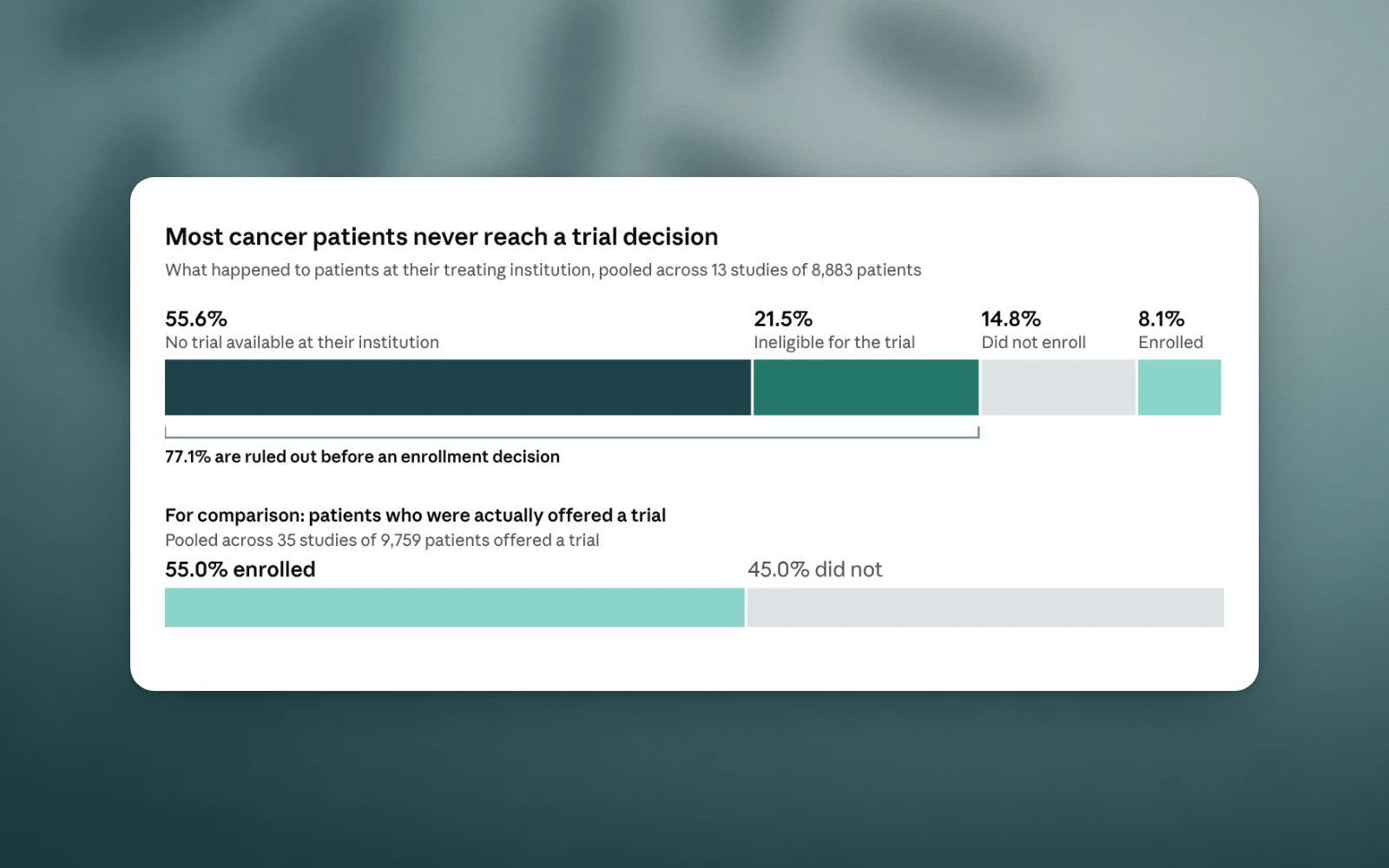
Fewer than one in ten adult cancer patients in the United States enrolls in a clinical trial. Low enrollment is often attributed to patients themselves, through cost, fear or mistrust of research. The pooled evidence supports a different explanation. Most patients who are offered a trial agree to take part, and most who never enroll are lost earlier in the process, either because no suitable trial is open at their institution or because their eligibility is not established in time.
To examine where enrollment fails, we screened more than 7,000 records across six bibliographic databases and reviewed 30 studies of enrollment barriers. This post summarizes what that literature shows and what it implies for research sites.
Patients agree more often than expected
A 2021 meta-analysis of 35 U.S. studies, covering 9,759 cancer patients who were offered trial participation, found that 55% enrolled (Unger et al.). Participation was similar among Black and White patients (58.4% and 55.1%), and the most common reasons for declining were a preference for another treatment or a lack of interest.
The patient’s decision therefore matters, but it accounts for a smaller share of non-enrollment than is often assumed. Only patients who have already passed through several earlier steps are ever asked to make it.
Most patients are lost before an offer is made
An earlier meta-analysis by the same group classified 8,883 patients from 13 studies along a single decision pathway (Unger et al.). For most of these patients, the question of whether to enroll never arose.
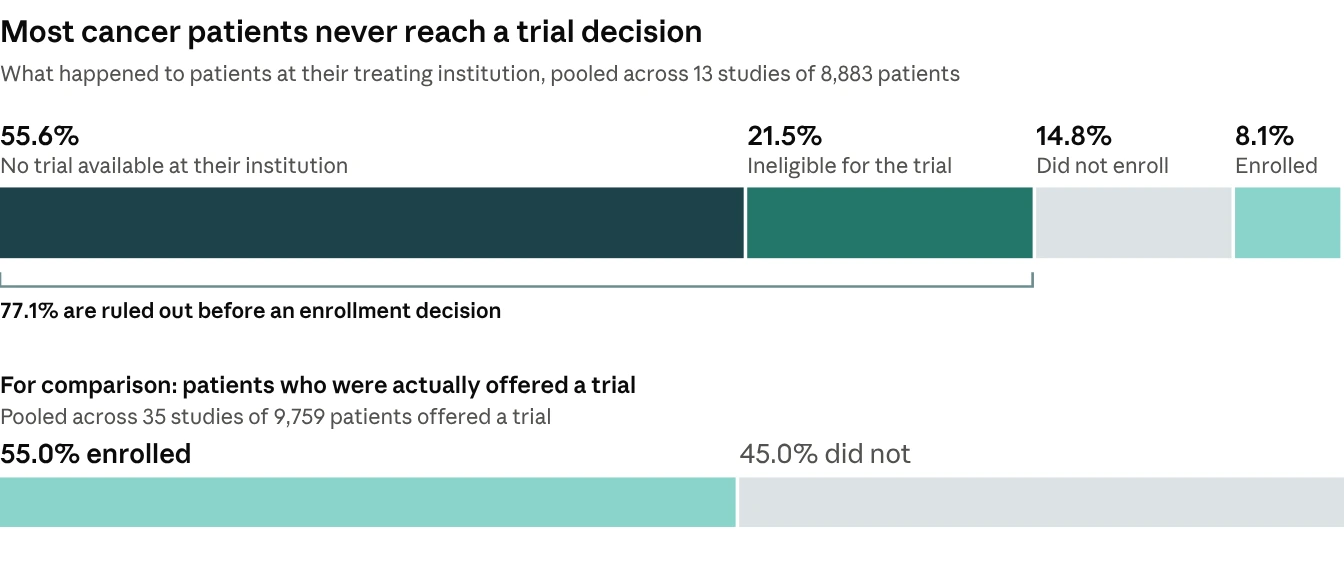
Enrollment was lower in community practices than in academic centers (7.0% versus 15.9%), yet the proportions of patients lost to trial unavailability, ineligibility and non-enrollment did not differ by setting. The losses appear to be structural rather than specific to one type of institution.
What the literature emphasizes
In our own review, we coded every barrier reported in the results of 20 U.S. oncology studies published between 2021 and 2023, which yielded 143 barrier mentions.
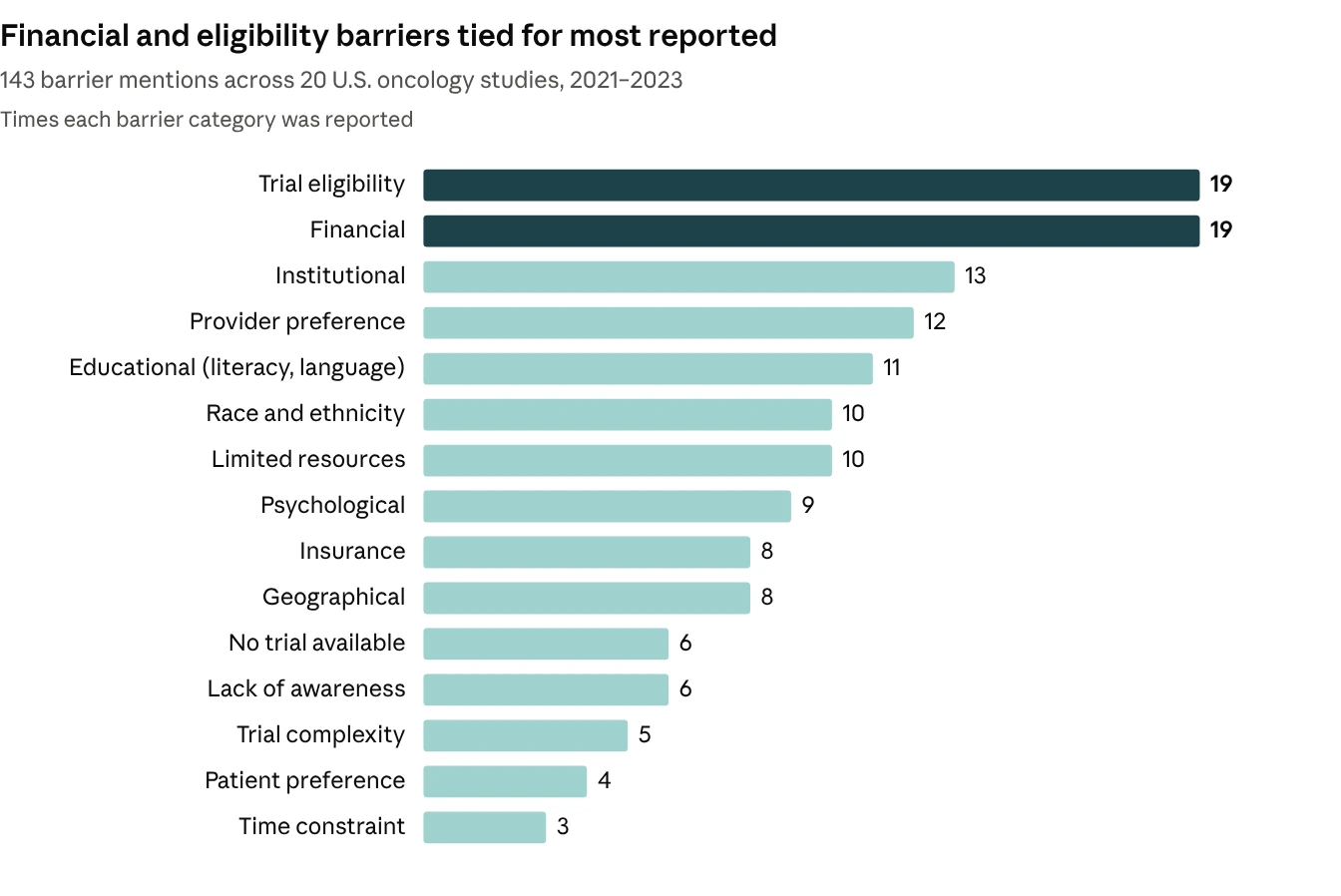
Patient-level barriers, including cost, health literacy and mistrust, accounted for 37% of these mentions, the largest share of any theme. The literature thus concentrates on the patient, whereas the pathway data locate most losses upstream of the patient’s decision.
Eligibility, the most frequently cited system-level barrier, is itself partly a matter of timing. Several studies described patients who were excluded because they had already begun another line of treatment by the time their eligibility was assessed (Sae-Hau et al.; Hass et al.).
Screening as the operational bottleneck
The provider-focused studies in our review used heterogeneous methods, but they describe a consistent bottleneck: the identification of eligible patients is largely manual and unevenly applied. In a survey of 693 providers, only 49.2% reported screening every patient for onsite trials, and 81.9% relied on manual chart review to do so (Durden et al.). At a comprehensive cancer center, 84.4% of physicians reported difficulty keeping track of eligibility criteria for open studies (Hillyer et al.). In a national sample of 1,030 oncologists, only 30% discussed trials with more than a quarter of their patients (Lee et al.).
Awareness and follow-up show similar gaps. Among stakeholders at Children’s Oncology Group sites, 45% were unaware of a relevant supportive care trial; seven sites opened it, and one enrolled a patient (Mittal et al.). Only 22% of neuro-oncology providers reported that their center tracks referrals to trials inside and outside the institution (Rogers et al.). Interviews at community clinics found that low-enrolling sites struggled at the earliest step, identifying eligible trials, whereas high-enrolling sites met their barriers later in the process (Siembida et al.).
None of these findings describes a patient declining to participate. Each describes a point at which a patient was not screened, or a clinician did not know that a trial was available.
Which barriers are modifiable, and by whom
The barriers in this literature differ in who is positioned to address them. Out-of-pocket costs, travel and lost wages depend largely on coverage policy and sponsor budgets. Trial availability and restrictive eligibility criteria are set by sponsors, cooperative groups and the composition of a site’s trial portfolio, and in the pooled pathway data these two factors account for most of the patients lost. Screening practices, by contrast, fall within a site’s own control: whether every patient is assessed, whether assessment happens before the next line of therapy begins, whether clinicians know which studies are open, and whether referrals are tracked.
Screening is therefore the barrier a site can modify most directly, and it is also where the evidence is most consistent. Both studies by Siembida and colleagues identified a systematic screening process among the principal facilitators of enrollment (2021; 2022). Durden and colleagues concluded that automated screening embedded in clinical workflows could make eligibility assessment routine, including for trials offered at other sites.
Better screening may also reduce losses attributed to the other categories. Part of what is classified as “no trial available” likely reflects trials at other institutions that were never identified, and Durden and colleagues found that referrals to offsite trials were uncommon.
The unmeasured step in the enrollment pathway
We had intended to pool the provider-focused studies into a single estimate but were unable to do so. The studies used at least five different units of analysis: surveyed providers, interviewed staff, surveyed patients, sites, and patients followed through care. Seven of the 11 reported only descriptive percentages or qualitative themes without inferential testing, and almost none reported how many patients had been screened.
This gap in the research mirrors a gap in practice. A site seeking to understand where its patients are lost would need, at a minimum, six counts:
- Patients seen
- Patients screened for any trial
- Patients with a trial available
- Patients eligible
- Patients offered a trial
- Patients enrolled
Most sites can report the last of these. Far fewer can report the second, which is consistent with the finding that screening remains largely manual and ad hoc.
What we are building
Centrova’s platform is designed to automate this screening step. It reviews the clinical notes and documents a site already holds and compares each patient against the inclusion and exclusion criteria of every open trial. Coordinators and investigators review the resulting candidates and retain responsibility for the final eligibility determination.
The aim is for every patient to be assessed against every open protocol without a separate manual chart review for each one. Patient tracking records where each candidate stands, so a site can see where losses occur in its own enrollment pathway. The platform works across disease areas and with multiple EHR systems, and testing is free during development. Research sites interested in evaluating it can contact us.
Methods
We conducted the literature search in two stages. The first covered U.S. oncology studies published between 2021 and 2023. The second rebuilt the search to systematic-review standards across four databases for 2018 to 2024, with paired, blinded screening in Rayyan.
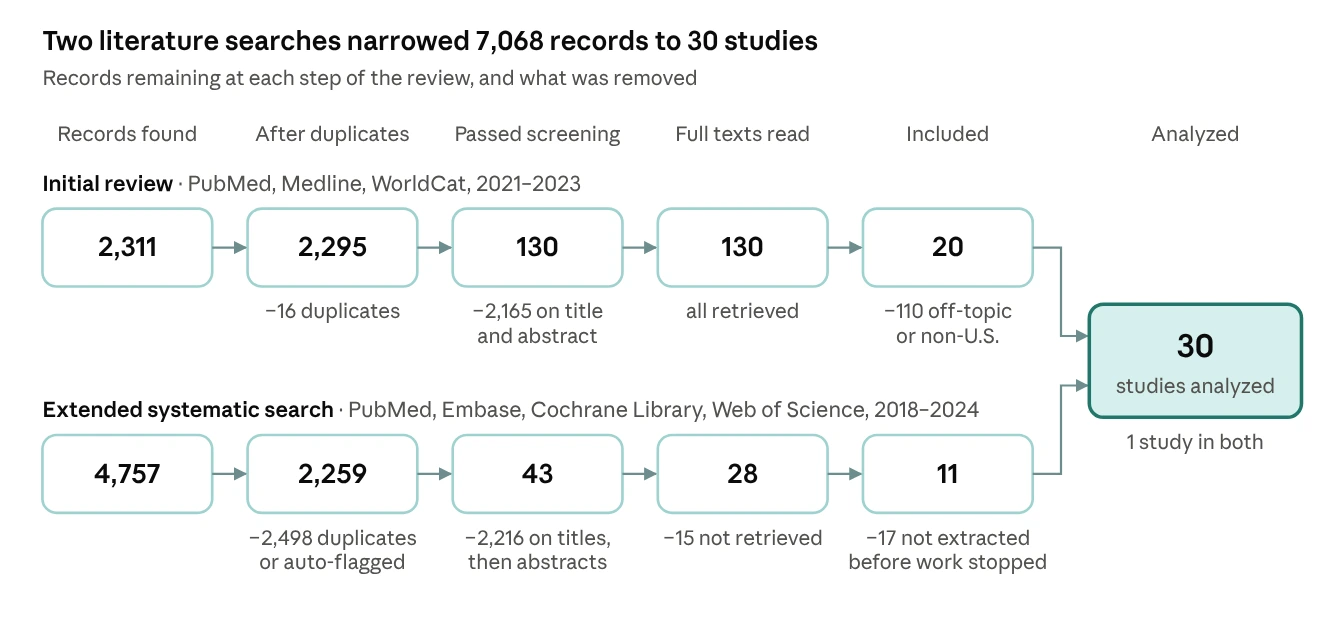
In the first stage, all 143 reported barriers were coded independently and blinded into 15 categories and four themes. The second stage was halted at data extraction, before any pooling was attempted. Two limitations apply throughout. Counts of mentions reflect the attention a barrier receives rather than its effect on enrollment, and most included studies relied on surveys and interviews rather than direct observation of screening. Search strings and extraction sheets are available on request.
Sources
- Unger JM, Vaidya R, Hershman DL, et al. Systematic review and meta-analysis of the magnitude of structural, clinical, and physician and patient barriers to cancer clinical trial participation. J Natl Cancer Inst. 2019;111(3):245-255.
- Unger JM, Hershman DL, Till C, et al. “When offered to participate”: a systematic review and meta-analysis of patient agreement to participate in cancer clinical trials. J Natl Cancer Inst. 2021;113(3):244-257.
- Durden K, Hurley P, Butler DL, et al. Provider motivations and barriers to cancer clinical trial screening, referral, and operations: findings from a survey. Cancer. 2024;130(1):68-76.
- Hillyer GC, Beauchemin M, Hershman DL, et al. Discordant attitudes and beliefs about cancer clinical trial participation between physicians, research staff, and cancer patients. Clin Trials. 2020;17(2):184-194.
- Lee SJC, Murphy CC, Gerber DE, et al. Reimbursement matters: overcoming barriers to clinical trial accrual. Med Care. 2021;59(5):461-466.
- Mittal N, Langevin AM, Kyono W, et al. Barriers to pediatric oncologist enrollment of adolescents and young adults on a cross-network National Clinical Trials Network supportive care cancer clinical trial. J Adolesc Young Adult Oncol. 2022;11(1):117-121.
- Rogers JL, Acquaye A, Vera E, et al. Provider-reported challenges and barriers to referring patients to neuro-oncology clinical trials. Neurooncol Pract. 2020;7(1):38-51.
- Siembida EJ, Loomans-Kropp HA, Tami-Maury I, et al. Barriers and facilitators to adolescent and young adult cancer trial enrollment: NCORP site perspectives. JNCI Cancer Spectr. 2021;5(3).
- Siembida EJ, Loomans-Kropp HA, Tami-Maury I, et al. Comparing barriers and facilitators to adolescent and young adult clinical trial enrollment across high- and low-enrolling community-based clinics. Oncologist. 2022;27(5):363-370.
- Sae-Hau M, Disare K, Michaels M, et al. Overcoming barriers to clinical trial participation: outcomes of a national clinical trial matching and navigation service for patients with a blood cancer. JCO Oncol Pract. 2021;17(12):e1866-e1878.
- Hass A, Guzman JCA, Feuerstein MA. Interventions to improve access to clinical trials in urologic oncology. Can Urol Assoc J. 2023;17(3):E67-E74.