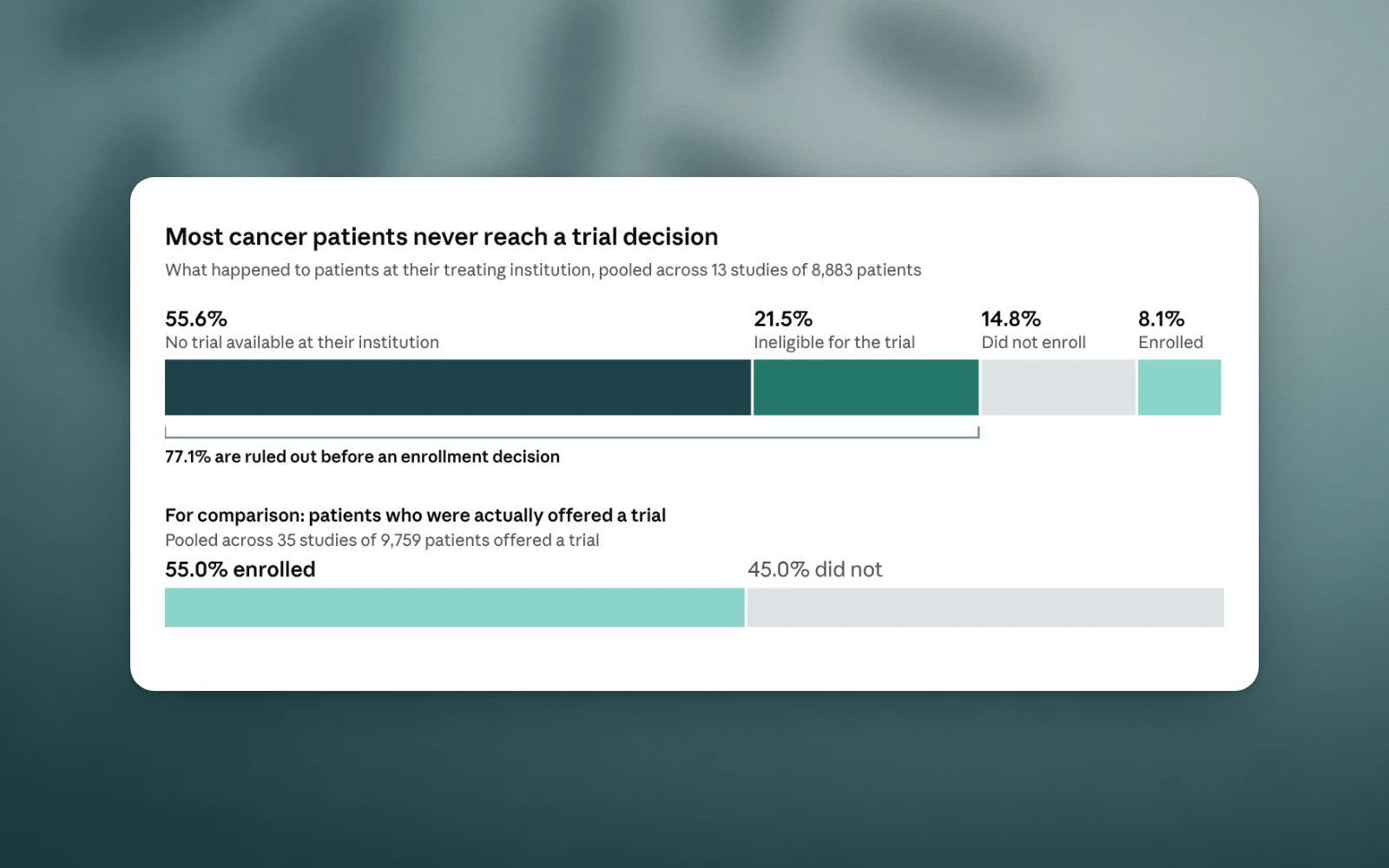

Differences in who joins clinical trials are usually described as differences in who is willing. The studies that measure each step separately point to an earlier stage. When patients of different races are actually offered a trial, they agree at similar rates: in a meta-analysis of 35 U.S. cancer studies, 58.4% of Black patients and 55.1% of White patients who were offered a trial enrolled. Where gaps appear, they are more often found in who is identified, screened and approached, and the evidence is clearest for race, age and language.
This post reviews that evidence across disease areas, summarizes U.S. policy on trial diversity, and describes what a site can measure. Several results come from single institutions, so the claims are limited accordingly.
Patients who are offered a trial agree at similar rates
A 2021 meta-analysis of 35 studies covering 9,759 patients offered a cancer trial found that 55.0% (95% CI 49.4% to 60.5%) agreed to enroll, with participation of 58.4% among Black patients and 55.1% among White patients (Unger et al.).
A more recent survey of 1,150 women in a Chicago breast cancer cohort points the same way. Of 443 patients who had been offered a trial, 285 (64.3%) participated, and differences across racial and ethnic groups were not significant after adjustment for sociodemographic and clinical factors (Chen et al.). The pattern is not universal. At a single pediatric center, 90.1% of 464 trial-eligible children with hematologic malignancies were offered a frontline trial and 85% of those enrolled, yet non-Hispanic Black patients were less likely to enroll in adjusted analysis (OR 0.4, 95% CI 0.20 to 0.8) (Monroe et al.).
Offers vary more than decisions do
The step that precedes the decision, being offered a trial at all, shows larger differences in the studies that measured it. In a physician survey of 319 newly evaluated women with breast cancer at one academic center, 33% were offered a trial. Black women were offered trials less often than White women (21% versus 42%), and older women were offered them less often than younger ones, yet neither factor predicted enrollment among those who were offered (Simon et al.). That study dates from 1996 to 1997 and reflects one center, so it illustrates a mechanism and is not a current estimate.
Age shows a similar pattern in a more recent Canadian sample of 503 consecutive oncology consultations. Each additional decade of age was associated with lower odds of a trial offer (OR 0.74, 95% CI 0.6 to 0.9) after adjustment for patient factors and stage, although the most common reason oncologists gave for not offering a trial overall was that none was available (75.4%) (Lackman et al.). In a survey of 300 solid tumor patients at a Midwest academic center, only 96 (32%) had ever been asked to take part in a trial (Moreland et al.).
The evidence on how clinicians decide whom to approach is mostly qualitative. In interviews with 27 health care professionals about referral to a stroke rehabilitation trial, clinicians described anticipating how a patient would respond and tended to refer only those they expected to respond positively, which the authors characterized as a gatekeeping effect (Thomas et al.). In the Chicago cohort, by contrast, trial discussion did not differ significantly by race (Chen et al.). Our reading is that the risk varies by setting, which is the reason to measure it.
Eligibility criteria can exclude by language before screening starts
Some exclusions are written into protocols. Among 14,367 adult interventional trials with a U.S. site registered on ClinicalTrials.gov between January 2019 and December 2020, 18.98% required the ability to read, speak or understand English, and 2.71% mentioned accommodating another language (Muthukumar et al.). The requirement was more common in federally funded trials (28.86%) than in industry-funded trials (5.30%), and it appeared in 52.24% of the depression trials with posted protocols that the authors examined.
Practical choices at the site matter as well. At one academic hospital serving a predominantly Spanish-speaking population, gynecologic oncology trials opened before 2019 all had fully translated consent forms and 70% of enrolled participants were Hispanic, whereas after institutional support for translation ended only one of eight new trials had a translated form and 10% of enrolled participants were Hispanic (Guo et al.). In a cancer population in Sydney, patients whose preferred language was not English were less likely to be enrolled in a trial than patients born in English-speaking countries (OR 0.45, 95% CI 0.36 to 0.56) (Smith et al.). These are associations from single settings, but they locate part of the gap in access to consent materials and eligibility rules rather than in patient preference.
Where U.S. policy stands as of November 2026
The Food and Drug Omnibus Reform Act of 2022 was enacted on December 29, 2022 (Public Law 117-328). According to law firm and trade summaries, it requires sponsors of phase 3 and other pivotal studies to submit diversity action plans with enrollment goals by age group, sex, race and ethnicity, and the requirement applies to studies that begin enrolling 180 days after FDA publishes final guidance (Bass, Berry & Sims; Applied Clinical Trials). FDA issued draft guidance on June 26, 2024, with comments due September 26, 2024.
In January 2025, following executive orders issued on January 20 and 21, the draft guidance was reported removed from FDA’s website on January 23, 2025 (Crowell & Moring). On February 11, 2025, the U.S. District Court for the District of Columbia issued a temporary restraining order in Doctors for America v. Office of Personnel Management, and FDA began restoring pages on February 12, including the diversity action plan guidance (AgencyIQ). On July 2, 2025, the court granted summary judgment to the plaintiffs on two counts and ordered the websites restored to their status as of January 29, 2025. The case docket shows no appeal, and the government filed a final compliance report in December 2025 (Clearinghouse).
The statutory date for final guidance was reported as June 26, 2025 (Pink Sheet; Crowell & Moring). FDA’s guidance page, last updated July 25, 2025, still labels the document a draft marked “Not for implementation,” and notes that HHS is required by court order to restore the page to its January 29, 2025 version (FDA). We found no final guidance. Separately, FDA reissued its 2020 guidance on eligibility criteria and enrollment practices in December 2025 as Revision 1, retitled “Enhancing Participation in Clinical Trials”; the revised text omits the word “diversity” while still discussing sex, race, ethnicity and age (FDA). Post 4 describes its eligibility recommendations.
What systematic screening can and cannot do
Screening every patient against every open trial removes one source of variation, the decision about whom to think of. A matching patient appears on the list whether or not a busy clinician recalls the study, and the site can record who was identified, who was offered and who was not. That record makes selective offering visible.
Screening has limits. It depends on the data a site holds, and if race, ethnicity, preferred language or key clinical details are missing or inconsistent in the record, the site cannot see its own gaps and a screening tool can inherit them. Screening cannot create trials. In the Canadian sample, absence of a suitable trial was the leading reason for no offer, and a single Georgia cancer center found no significant difference in enrollment between rural and urban counties, so we do not claim that screening alone closes geographic gaps (Kurilo and Pentz). A match also does not help a patient who cannot be consented in a language they understand.
For a site, the measurable steps follow from this. Count the patients seen, screened, matched, offered and enrolled, and break each count down by race, ethnicity, age and preferred language. Review which open protocols require English and whether translated consent forms exist. Compare the offered group with the matched group, since a difference there points to the offer stage.
What we are building
Centrova’s platform reviews the clinical notes and documents a site already holds and checks each patient against the inclusion and exclusion criteria of open trials. Coordinators and investigators review the candidates and make the final eligibility determination. It also includes patient tracking, communication and site coordination tools, and it works across disease areas and with multiple EHR systems. Testing is free during development; sites can contact us.
This post is general information, not legal or regulatory advice.
Sources
- Unger JM, Hershman DL, Till C, et al. “When offered to participate”: a systematic review and meta-analysis of patient agreement to participate in cancer clinical trials. J Natl Cancer Inst. 2021;113(3):244-257. https://doi.org/10.1093/jnci/djaa155
- Chen N, Freeman JQ, Zhao F, et al. Clinical trial discussion and participation in a breast cancer cohort by race and ethnicity. JAMA Netw Open. 2025;8(6):e2515205. https://doi.org/10.1001/jamanetworkopen.2025.15205
- Monroe C, Muñiz JP, Leong T, et al. Disparities in clinical trial participation in children and adolescent patients with a hematologic malignancy. Pediatr Blood Cancer. 2025;72(6):e31641. https://doi.org/10.1002/pbc.31641
- Simon MS, Du W, Flaherty L, et al. Factors associated with breast cancer clinical trials participation and enrollment at a large academic medical center. J Clin Oncol. 2004;22(11):2046-2052. https://doi.org/10.1200/JCO.2004.03.005
- Lackman M, Vickers MM, Hsu T. Physician-reported reasons for non-enrollment of older adults in cancer clinical trials. J Geriatr Oncol. 2020;11(1):31-36. https://doi.org/10.1016/j.jgo.2019.01.019
- Moreland K, Butsch Kovacic M, Rai S, Sohal D. Disparities in clinical trial participation: a cross-sectional survey of cancer patients at a Midwest academic medical center. Curr Oncol. 2024;31(9):5367-5373. https://doi.org/10.3390/curroncol31090396
- Thomas N, Plant S, Woodward-Nutt K, Prior Y, Tyson S. Health care professionals’ views of the factors influencing the decision to refer patients to a stroke rehabilitation trial. Trials. 2015;16:577. https://doi.org/10.1186/s13063-015-1115-1
- Muthukumar AV, Morrell W, Bierer BE. Evaluating the frequency of English language requirements in clinical trial eligibility criteria: a systematic analysis using ClinicalTrials.gov. PLoS Med. 2021;18(9):e1003758. https://doi.org/10.1371/journal.pmed.1003758
- Guo XM, Neuman MK, Vallejo A, Matsuo K, Roman LD. An absence of translated consent forms limits oncologic clinical trial enrollment for limited English proficiency participants. Gynecol Oncol. 2024;180:86-90. https://doi.org/10.1016/j.ygyno.2023.11.025
- Smith AB, Agar M, Delaney G, et al. Lower trial participation by culturally and linguistically diverse (CALD) cancer patients is largely due to language barriers. Asia Pac J Clin Oncol. 2018;14(1):52-60. https://doi.org/10.1111/ajco.12818
- Kurilo T, Pentz RD. Comparative analysis of breast and lung cancer survival rates and clinical trial enrollments among rural and urban patients in Georgia. Oncol Res. 2024;32(9):1401-1406. https://doi.org/10.32604/or.2024.050266
- U.S. Congress. Consolidated Appropriations Act, 2023, Public Law 117-328 (enacted December 29, 2022). https://www.govinfo.gov/content/pkg/PLAW-117publ328/html/PLAW-117publ328.htm
- U.S. Food and Drug Administration. Diversity action plans to improve enrollment of participants from underrepresented populations in clinical studies: draft guidance for industry (June 2024; page content current as of July 25, 2025). https://www.fda.gov/regulatory-information/search-fda-guidance-documents/diversity-action-plans-improve-enrollment-participants-underrepresented-populations-clinical-studies
- U.S. Food and Drug Administration. Enhancing Participation in Clinical Trials: Eligibility Criteria, Enrollment Practices, and Trial Designs. Guidance for Industry, Revision 1. December 2025. https://www.fda.gov/media/190162/download
- Clearinghouse. Doctors for America v. Office of Personnel Management, No. 1:25-cv-00322 (D.D.C.), case summary and docket. https://clearinghouse.net/case/46029/
- Secondary sources, used for context and labeled as such: Bass, Berry & Sims, FDA’s diversity action plans for clinical trials (July 2, 2024), link; Applied Clinical Trials, FDA issues draft guidance on the submission of diversity action plans (June 2024), link; Crowell & Moring, After Trump executive orders, FDA removes diversity guidance from website (2025), link; AgencyIQ, FDA begins restoring some documents following court order (February 2025), link; Pink Sheet (Citeline), Future of US FDA’s diversity action plan guidance up in the air as statutory deadline looms (June 6, 2025), link