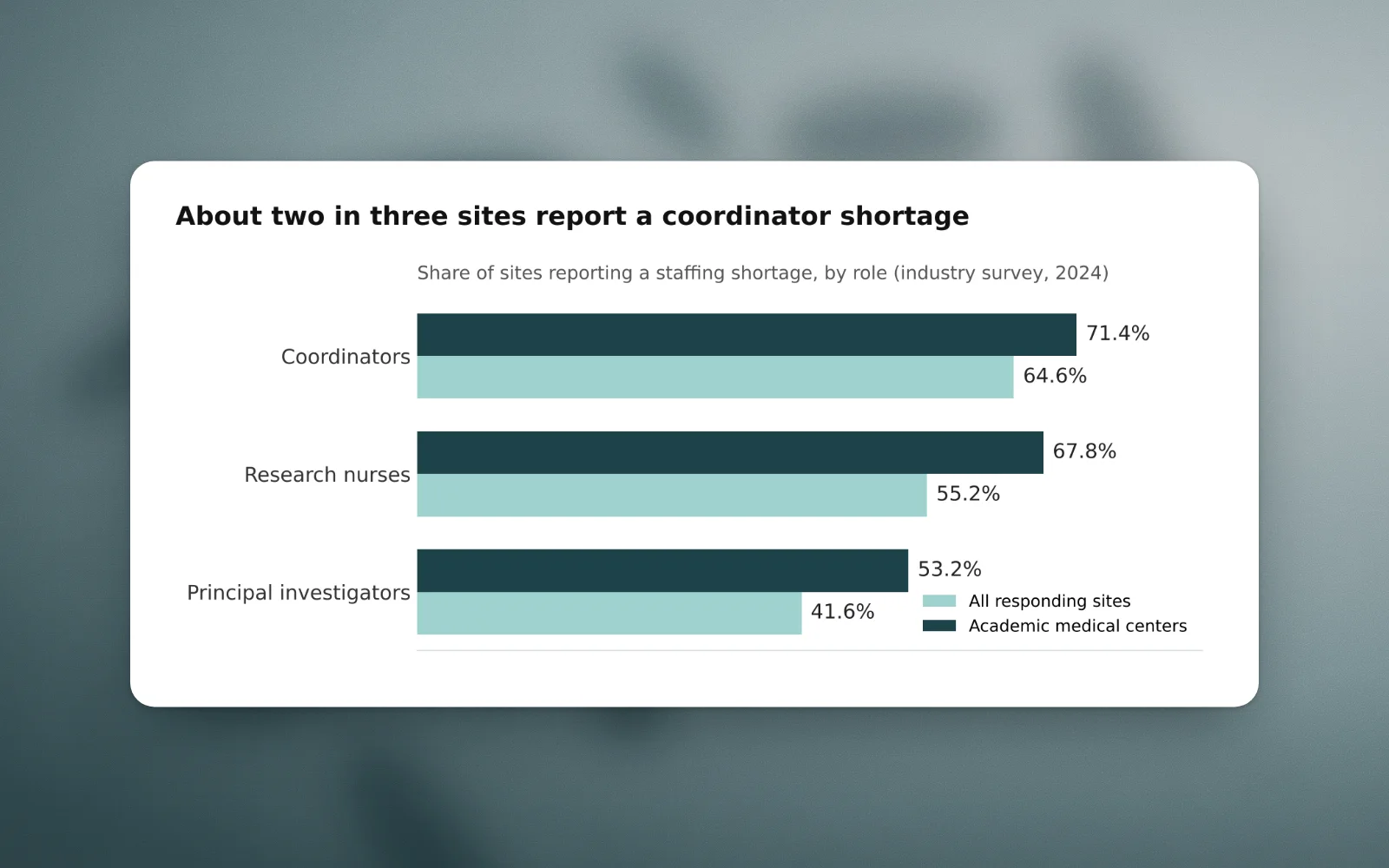
Research sites report that coordinators are among their scarcest staff, and the protocols those coordinators run keep growing. In an industry survey by Advarra fielded in 2024, which does not report its number of respondents, 64.6% of responding sites reported a shortage of clinical research coordinators, and 71.4% of academic medical centers did (Advarra). In a Tufts benchmark of protocols completed just before the pandemic, a typical phase II or III protocol carried about 30 inclusion and exclusion criteria (Getz et al.). Checking every patient against that many criteria, for every open study, is repetitive information retrieval, and it competes for the same hours as consent visits, data entry and follow-up.
Evaluations of software-assisted prescreening consistently report less chart-review effort. The evidence that this raises enrollment is thinner, and it comes mostly from single-site studies. The tasks that depend on judgment and on the relationship with the patient remain with people.
Shortages and turnover are widely reported
Industry surveys describe unusually high turnover. The Society for Clinical Research Sites reported from its 2022 survey that turnover among patient-facing site staff had risen to 35% to 61%, against a usual range of 10% to 37%, and that 85% of staff who left sites went to sponsors or contract research organizations (SCRS). The same report estimated the cost of recruiting and training a replacement at about six months of pay and said it can take 6 to 12 months for a site to get back on track with a study after a coordinator leaves. The document does not state its sample size, so these figures indicate direction more than precise magnitude.
In the Advarra survey, 29.2% of respondents rated staff leaving to join a sponsor or CRO as an extremely or very significant cause of shortages, 24.7% said the same of staff moving to another site organization, and 30% to 35% expected vacancies to worsen between 2024 and 2029 (Advarra).
Peer-reviewed work points the same way, with smaller samples. A survey of 85 current and former coordinators described the role as having changed from a semi-permanent position to one with high turnover, and found that adequate salary and an engaged, respectful principal investigator were associated with retention. Workload itself was not associated with retention in that sample (Buchanan et al.), so the evidence that workload drives departures is mixed. Leaders from 35 academic centers reported substantial increases in unfilled clinical research professional positions (Knapke et al.). In a survey of 202 coordinators in China, longer weekly work hours were associated with intention to leave (Li et al.), and among 121 oncology coordinators in Israel, role overload was associated with lower job satisfaction, which in turn was associated with burnout (Kidron et al.).
Protocol complexity has grown in nearly every dimension
The Tufts Center for the Study of Drug Development analyzed 187 protocols from 20 sponsors and contract research organizations, all approved between 2013 and 2018. Phase II and III protocols averaged 30.9 and 30.4 inclusion and exclusion criteria, 20.7 and 18.6 endpoints, and, for phase III, 266.0 procedures per protocol (Getz et al.). Between 2009 and 2020, mean procedures per protocol and mean countries rose by slightly less than 70%, investigative sites by 33.0% and endpoints by 27.1%. The authors state that benchmarked designs have not yet shown a downward trend in any design element.
Complexity is not confined to one disease area. Oncology and non-oncology protocols carried similar numbers of eligibility criteria (29.8 and 31.0), though oncology protocols had more total procedures (315 versus 243). A companion Tufts analysis of the same 187 protocols found that the number of endpoints, eligibility criteria and procedures per visit predicted cycle time, enrollment and retention outcomes, even after controlling for phase and therapeutic area (Smith et al.). The sample consists of protocols selected by participating companies, so the means serve as benchmarks and do not estimate the population of all protocols.
Evidence on how many studies each coordinator carries is old. A 2012 trade-press report on a coordinator survey cited a median that rose from 4.3 studies per coordinator in 2001 to 7 in 2011, and described those figures as based on anecdotal site reports (Getz). We did not find a more recent peer-reviewed estimate.
Manual prescreening scales with patients and trials
Prescreening effort grows with the product of patients and open studies. In a retrospective analysis at a pediatric oncology center, replicating historical enrollment decisions without automation would have required reviewing an average of 163 patients per trial, or 42 trials per patient (Ni et al.). In a community breast cancer practice, manual eligibility screening of 90 patients for three trials took 110 minutes (Beck et al.). At a comprehensive cancer center, reviewing a chart took 3.1 minutes on average before automated pre-filtering (Gong et al.). Each figure is small per chart. Multiplied across a clinic’s patients and a site’s portfolio, it becomes a standing demand on coordinator time.
What automated prescreening has shown so far
The studies we found are mostly single-site, uncontrolled evaluations. Their time findings agree with one another, whereas their enrollment findings are limited.
In the breast cancer evaluation, system-assisted determinations for the same 90 patients and three trials took 24 minutes instead of 110 (Beck et al.). Sensitivity was 91% to 95% for three of the four trials and 46.7% for the fourth, so the tool missed more than half of the eligible patients for one study. In the pediatric oncology analysis, automation cut the review workload by 85%, but precision was 12.6%: most flagged patients would not have been enrolled (Ni et al.).
The Yale implementation is the largest enrollment dataset. Across 29 trials, the system screened 98,348 patients and identified 825 eligible candidates, and 117 patients enrolled, with consent rates of 9% to 37% depending on the trial. After validation on a colorectal cancer trial, the abstract reports, implementation cut chart review workload ten-fold and time per reviewed chart by 41%, from 3.1 to 1.8 minutes (Gong et al.). No comparison group shows how many patients would have enrolled under manual screening alone.
Alerts inside the EHR give mixed results. In a pediatric obesity trial, a best practice alert reached 2,121 patients and accounted for 177 of 261 enrolled participants (68%) (Scott et al.). In a perioperative implementation study at a large academic center, clinicians adhered to 51.2% of 10,592 automated prompts, and adherence varied with team composition, from 42.2% for solo attendings to 57.4% for full teams (Gabel et al.). Finding the patient is a different problem from acting on the finding. Dedicated screening staff are one way sites address it: a conference poster from one cancer center reported more than a 50% increase in prescreened patients in disease programs that hired clinical trial screening coordinators (Moffitt Cancer Center).
Which work software can take on and which it cannot
Our reading of this evidence is that the division of labor follows the type of task. Matching a patient’s documented history to a list of criteria, keeping a record of who has been reviewed for which study, and surfacing candidates promptly are retrieval tasks, and the studies above measured their review time falling, for example from 110 to 24 minutes for the same 90 patients and three trials. That is where the time savings were measured.
The remaining steps depend on people. A sensitivity of 46.7% on one trial and a precision of 12.6% on another show that candidate lists need clinical review, and borderline eligibility questions, such as an ambiguous laboratory value or an uncertain treatment history, call for investigator judgment. The 9% to 37% consent rates in the Yale data show that identification does not decide enrollment. The conversation with the patient does, and so do the working relationships that the retention studies find matter to coordinators themselves.
What we are building
Centrova’s platform reviews the clinical notes and documents a site already holds and checks each patient against the inclusion and exclusion criteria of open trials. Coordinators and investigators review the candidates and make the final eligibility determination. It also includes patient tracking, communication and site coordination tools, works across disease areas and with multiple EHR systems, and testing is free during development. Sites can contact us.
Sources
- Advarra. The State of Workforce Development: 2025 Survey Report (industry survey fielded August to October 2024; number of respondents not reported). https://resource.advarra.com/hubfs/eBook/Advarra%20Workforce%20Development%20Survey%20Report%20EB.pdf
- Society for Clinical Research Sites. Workforce Challenges at Clinical Research Sites, from the 2022 Site Landscape Survey. 2023. https://myscrs.org/wp-content/uploads/2024/07/SCRS-2023-whitepaper_v5.pdf
- Getz K, Smith Z, Kravet M. Protocol Design and Performance Benchmarks by Phase and by Oncology and Rare Disease Subgroups. Ther Innov Regul Sci. 2023;57(1):49-56. https://doi.org/10.1007/s43441-022-00438-5
- Smith Z, Bilke R, Pretorius S, Getz K. Protocol Design Variables Highly Correlated with, and Predictive of, Clinical Trial Performance. Ther Innov Regul Sci. 2022;56(2):333-345. https://doi.org/10.1007/s43441-021-00370-0
- Buchanan DA, Goldstein J, Pfalzer AC, Lin YC, Kang H, Claassen DO. Empowering the Clinical Research Coordinator in Academic Medical Centers. Mayo Clin Proc Innov Qual Outcomes. 2021;5(2):265-273. https://doi.org/10.1016/j.mayocpiqo.2020.09.014
- Knapke JM, Snyder DC, Carter K, et al. Issues for recruitment and retention of clinical research professionals at academic medical centers: Part 1, collaborative conversations Un-Meeting findings. J Clin Transl Sci. 2022;6(1):e80. https://doi.org/10.1017/cts.2022.411
- Li J, Li J, She Z, Guo L, Gu S, Lu W. Turnover intention and its related factors of clinical research coordinator in Hunan, China: a cross-sectional study. Sci Rep. 2024;14(1):16054. https://doi.org/10.1038/s41598-024-66960-8
- Kidron A, Ben-Dor R, Otap D, Barsky I, Cohen JE. Burnout in Oncology Clinical Research Coordinators: Underlying Factors and Role of Empathy as a Moderator. JCO Oncol Pract. 2026;OP2501282. https://doi.org/10.1200/OP-25-01282
- Getz K. Are CRCs Reaching Their Tipping Point? Applied Clinical Trials. 2012;21(11). Trade press, used for historical context only. https://www.appliedclinicaltrialsonline.com/view/are-crcs-reaching-their-tipping-point
- Ni Y, et al. Increasing the efficiency of trial-patient matching: automated clinical trial eligibility pre-screening for pediatric oncology patients. BMC Med Inform Decis Mak. 2015;15:28. https://doi.org/10.1186/s12911-015-0149-3
- Beck JT, et al. Artificial Intelligence Tool for Optimizing Eligibility Screening for Clinical Trials in a Large Community Cancer Center. JCO Clin Cancer Inform. 2020;4:50-59. https://doi.org/10.1200/CCI.19.00079
- Gong G, et al. Clinical Trial Patient Matching: A Real-Time, Common Data Model and Artificial Intelligence-Driven System for Semiautomated Patient Prescreening in Cancer Clinical Trials. JCO Clin Cancer Inform. 2026;10:e2500262. https://doi.org/10.1200/CCI-25-00262
- Scott AB, et al. The Feasibility of Using Best Practice Alerts in Pediatric Primary Care for Obesity Research. Acad Pediatr. 2026;26(4):103310. https://doi.org/10.1016/j.acap.2026.103310
- Gabel E, et al. Automating eligibility assessment and enrollment for sugammadex administration within an integrated perioperative workflow. JAMIA Open. 2026;9(1):ooag021. https://doi.org/10.1093/jamiaopen/ooag021
- Moffitt Cancer Center. Development of a Clinical Trials Screening Coordinator Role and Workflow to Improve Recruitment (poster hosted by AACI in its 2024 Clinical Research Innovation files; the poster itself names no meeting and reports outcomes as of January 2024). https://aaci-cancer.org/Files/Admin/CRI/2024/114%2D%2D%2DDevelopment%2Dof%2Da%2DClinical%2DTrials%2DScreening%2DCoordinator%2DRole%2Dand%2DWorkflow%2Dto%2DImprove%2DRecruitment%2Epdf