Regulators and professional societies have spent several years asking sponsors to justify and loosen trial exclusions, and the FDA finalized a further set of oncology eligibility guidances in July 2026. The available evidence indicates that this widens the pool of patients who can qualify: in one analysis of advanced lung cancer trials, a data-driven broadening of restrictive criteria more than doubled the eligible pool on average (Liu et al.). Protocols nonetheless still carry roughly 30 inclusion and exclusion criteria each, many of which depend on laboratory values, dates and medication histories, and some can only be answered from clinical notes. A larger pool of potentially eligible patients therefore reaches a trial only if sites screen systematically.
We did not find a study that measures directly how screening misses change as criteria are broadened. The argument below is an inference from separate bodies of evidence, and we mark the points where it goes beyond them.
What regulators have asked sponsors to change
The FDA’s cross-disease guidance on eligibility criteria, enrollment practices and trial designs was announced in the Federal Register in November 2020 (Federal Register). It is still in force as a final guidance, reissued under the same docket in December 2025 as Revision 1 and retitled “Enhancing Participation in Clinical Trials” (the 2020 title began “Enhancing the Diversity of Clinical Trial Populations”) (FDA). The text asks sponsors to “examine each exclusion criterion to determine if it is needed,” to base organ dysfunction exclusions on an appropriately specific measure (the example given is limiting heart failure exclusions to NYHA stages III and IV), to reduce exclusions tied to comorbidities and concomitant medications as safety data accumulate, and to consider whether restrictive phase 2 exclusions can be removed or modified for phase 3 (FDA guidance, pp. 4-5). It is not limited to oncology.
In oncology, the FDA has issued a series of criterion-specific guidances that followed recommendations from ASCO and Friends of Cancer Research. ASCO and Friends published working-group recommendations in 2017 on brain metastases, HIV, organ dysfunction and minimum age, and in 2021 on washout periods, concomitant medications, prior therapies, laboratory reference ranges and test intervals, and performance status (Friends of Cancer Research; Kim et al.).
| Oncology eligibility guidance | Status as of November 2026 | Date |
|---|---|---|
| Brain metastases | Final | July 2020 (FDA) |
| Organ dysfunction or prior or concurrent malignancies | Final | Announced July 13, 2020 (Federal Register) |
| Patients with HIV, hepatitis B or hepatitis C infections | Final | Announced July 13, 2020 (Federal Register) |
| Minimum age for pediatric patients | Final | July 2020 (FDA) |
| Performance status; washout periods and concomitant medications; laboratory values | Final, finalizing drafts released in April 2024 | Posted July 27, 2026 (RAPS; FDA) |
The 2026 guidances change the form of the criteria as well as their number. The washout guidance recommends that clinical and laboratory parameters “be used in place of time-based washout periods” and that any time-based washout be scientifically justified (FDA). The laboratory guidance recommends that laboratory values serve as exclusions “only when clearly necessary to mitigate potential safety concerns,” suggests ranges defined by laboratory reference values rather than fixed numbers, and allows a repeat test within a set period (FDA). The ASCO and Friends statement expects such changes to make eligibility easier to determine and to speed accrual (Kim et al.).
Restrictive criteria exclude most real-world patients in many diseases
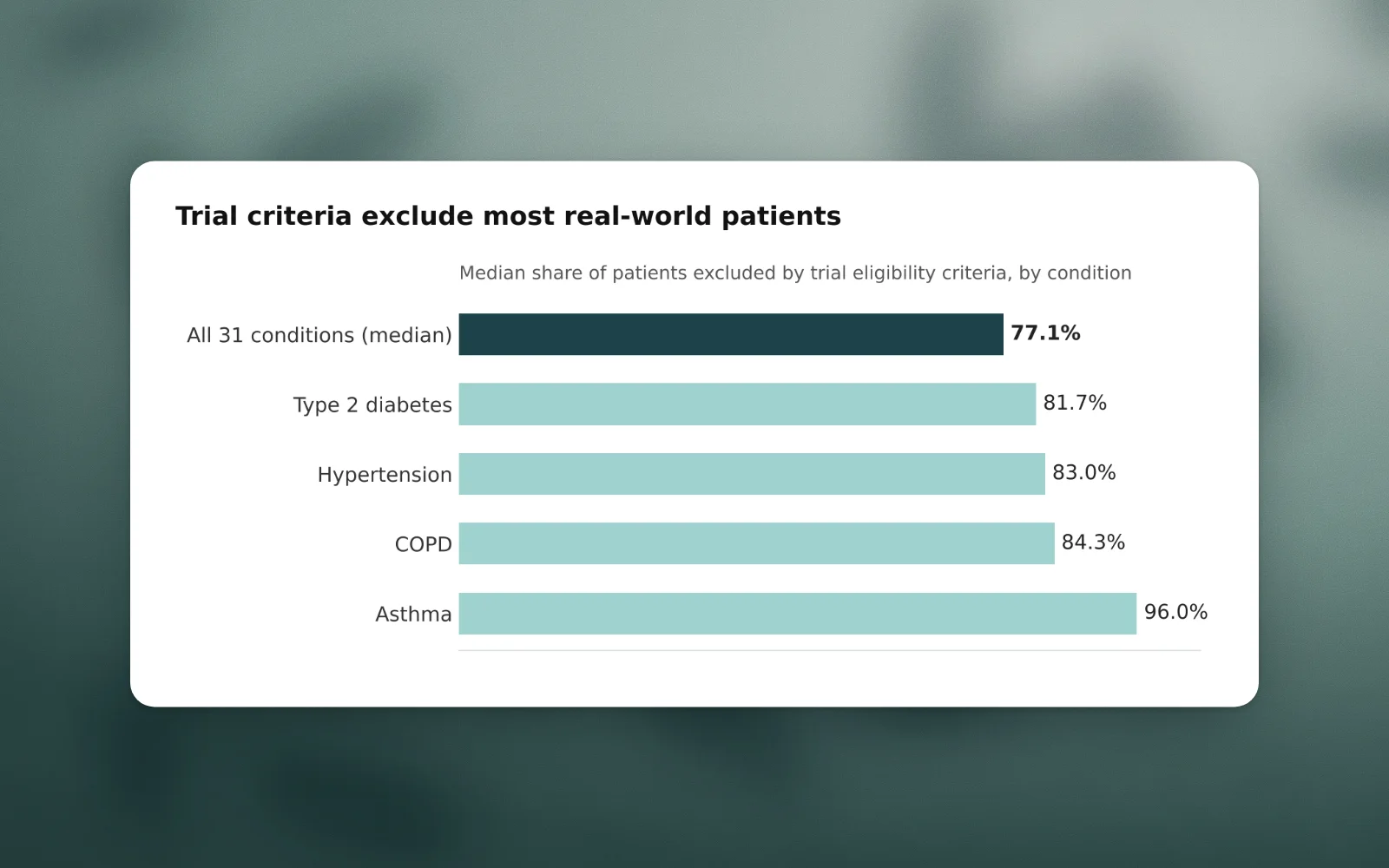
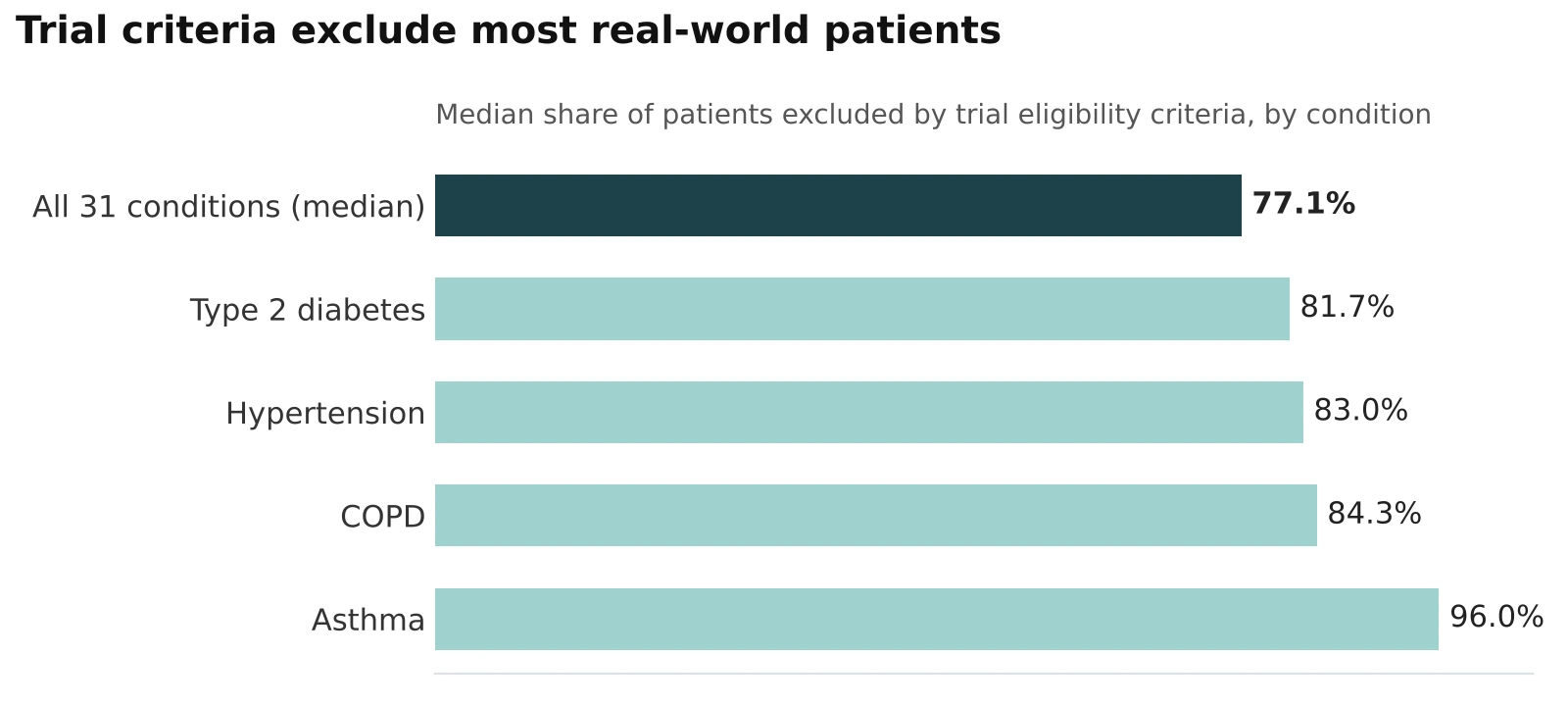
The case for broadening rests on how many patients current criteria exclude, and that evidence extends well beyond oncology. A systematic review of 50 studies covering 305 trials in 31 physical conditions found a median exclusion rate of 77.1% of patients with the condition, including 84.3% for COPD, 96.0% for asthma, 83.0% for hypertension and 81.7% for type 2 diabetes (He et al.). Age, comorbidity and co-prescribing were the most commonly applied exclusions, the authors considered their estimates likely to be low because most studies applied only a subset of criteria, and exclusion rates had not changed significantly in more recent trials.
Heart failure shows how much depends on the specific criteria. Of 99,767 patients with reduced ejection fraction discharged after acute decompensated heart failure in a U.S. registry, 71.8% met the inclusion criteria of the PIONEER-HF trial, but only 20.8% met inclusion and exclusion criteria together; 68.9% met a limited set of actionable criteria (Fudim et al.). In a single tertiary center, between 34% and 60% of 408 hospitalized heart failure patients met the basic criteria of the STRONG-HF trial, depending on whether NT-proBNP was applied (Bánfi-Bacsárdi et al.). In oncology, the lung cancer analysis above used records for 61,094 patients and found that many common criteria, including several laboratory exclusions, had minimal effect on trial hazard ratios (Liu et al.).
Protocols still carry many criteria
Broader criteria do not necessarily mean fewer criteria. Tufts CSDD data on 187 protocols completed before the pandemic put the mean at 30.9 inclusion and exclusion criteria for phase II and 30.4 for phase III, with a continuing upward trend across all protocol design variables (Getz et al.). Oncology and non-oncology protocols were similar (29.8 and 31.0). The same group reports that protocols with more eligibility criteria are associated with lower recruitment and retention rates (Getz et al.).
A separate analysis of 59 phase 3 inflammatory bowel disease trials registered between 2000 and 2022 found a median of 44 criteria that did not change significantly over time, together with variation across trials in washout periods, concomitant medication doses and laboratory tests (Outtier et al.). Both datasets predate the 2026 guidances, and we found no analysis yet of whether criteria counts fall after sponsors adopt them. A site screening for an open portfolio should therefore plan for criteria that are individually more flexible and collectively no fewer.
Why nuanced criteria are harder to apply by hand
The ASCO and Friends expectation of easier determination may hold where a criterion is reduced to a single threshold. Our inference concerns criteria that become more contextual: that criteria written as clinical judgments (recovery from an adverse event, a clinically relevant drug interaction, a repeat laboratory value within a window) are less likely to sit in a single structured field than a fixed cutoff. Direct evidence on how often eligibility information sits in notes is limited to individual studies. In the COPILOT-HF heart failure trial, structured EHR data could determine only 5 of 6 inclusion criteria and 5 of 17 exclusion criteria, so trained staff reviewed charts for the rest (Unlu et al., preprint).
Careful manual review still makes errors. Against an expert clinician’s blinded review, the COPILOT-HF study staff had a sensitivity of 90.1% and a specificity of 83.6% for overall eligibility, with accuracy on individual criteria ranging from 91.7% to 100% (Unlu et al.). At that sensitivity, roughly one in ten truly eligible patients would be classified as ineligible. In a crossover experiment with 12 clinicians assessing 4 stroke patients against 2 trials, accuracy using the standard EMR interface was 0.91, compared with 1.00 using a screening tool, and assessments took 3.18 minutes against 2.44 (Hu et al.). These are small, single-disease studies, but they point in the same direction as the Tufts data: each added or reworded criterion is another place where a chart review can go wrong, and the cost of an error is a missed or mistakenly advanced patient.
What sites can do
Several steps follow from this evidence without requiring new technology. A site can map each open trial’s criteria into those answerable from structured fields and those that need notes, because the second group determines where chart review effort is spent. It can record the specific criterion behind every screen failure, which makes it possible to see whether a loosened criterion has changed who qualifies. It can re-screen patients previously excluded when a protocol is amended. And it can screen every patient against every open trial on a fixed schedule, since the eligible pool for a trial now varies with criteria that sponsors are actively revising.
What we are building
Centrova’s platform reviews the clinical notes and documents a site already holds and checks each patient against the inclusion and exclusion criteria of open trials. Coordinators and investigators review the candidates and make the final eligibility determination. The platform also includes patient tracking, communication and site coordination tools, works across disease areas and with multiple EHR systems, and testing is free during development. Sites can contact us.
This post is general information, not legal or regulatory advice.
Sources
- FDA. Enhancing Participation in Clinical Trials: Eligibility Criteria, Enrollment Practices, and Trial Designs. Guidance for Industry, Revision 1, December 2025. https://www.fda.gov/regulatory-information/search-fda-guidance-documents/enhancing-participation-clinical-trials-eligibility-criteria-enrollment-practices-and-trial-designs (full text: https://www.fda.gov/media/190162/download)
- Federal Register. Enhancing the Diversity of Clinical Trial Populations: Eligibility Criteria, Enrollment Practices, and Trial Designs. November 10, 2020. https://www.federalregister.gov/documents/2020/11/10/2020-24881/enhancing-the-diversity-of-clinical-trial-populations-eligibility-criteria-enrollment-practices-and-trial-designs
- FDA. Cancer Clinical Trial Eligibility Criteria: Brain Metastases. July 2020. https://www.fda.gov/regulatory-information/search-fda-guidance-documents/cancer-clinical-trial-eligibility-criteria-brain-metastases
- Federal Register. Cancer Clinical Trial Eligibility Criteria: Patients with Organ Dysfunction or Prior or Concurrent Malignancies. July 13, 2020. https://www.govinfo.gov/content/pkg/FR-2020-07-13/html/2020-14996.htm
- Federal Register. Cancer Clinical Trial Eligibility Criteria: Patients with HIV, Hepatitis B Virus, or Hepatitis C Virus Infections. July 13, 2020. https://www.govinfo.gov/content/pkg/FR-2020-07-13/html/2020-14995.htm
- FDA. Cancer Clinical Trial Eligibility Criteria: Minimum Age Considerations for Inclusion of Pediatric Patients. July 2020. https://www.fda.gov/regulatory-information/search-fda-guidance-documents/cancer-clinical-trial-eligibility-criteria-minimum-age-considerations-inclusion-pediatric-patients
- FDA. Cancer Clinical Trial Eligibility Criteria: Performance Status. July 2026. https://www.fda.gov/regulatory-information/search-fda-guidance-documents/cancer-clinical-trial-eligibility-criteria-performance-status
- FDA. Cancer Clinical Trial Eligibility Criteria: Washout Periods and Concomitant Medications. July 2026. https://www.fda.gov/media/178016/download
- FDA. Cancer Clinical Trial Eligibility Criteria: Laboratory Values. July 2026. https://www.fda.gov/media/178013/download
- Regulatory Affairs Professionals Society (RAPS). FDA finalizes three guidances to broaden cancer clinical trial eligibility. July 2026 (secondary news, used for context). https://www.raps.org/resource/fda-finalizes-three-guidances-to-broaden-cancer-clinical-trial-eligibility.html
- Friends of Cancer Research. Clinical Trial Eligibility Criteria. https://friendsofcancerresearch.org/clinical-trial-eligibility-criteria/
- Kim ES, Uldrick TS, Schenkel C, et al. Continuing to broaden eligibility criteria to make clinical trials more representative and inclusive: ASCO-Friends of Cancer Research joint research statement. Clin Cancer Res. 2021;27(9):2394-2399. https://doi.org/10.1158/1078-0432.CCR-20-3852
- Liu R, Rizzo S, Whipple S, et al. Evaluating eligibility criteria of oncology trials using real-world data and AI. Nature. 2021;592(7855):629-633. https://doi.org/10.1038/s41586-021-03430-5
- He J, Morales DR, Guthrie B. Exclusion rates in randomized controlled trials of treatments for physical conditions: a systematic review. Trials. 2020;21(1):228. https://doi.org/10.1186/s13063-020-4139-0
- Fudim M, Sayeed S, et al. Representativeness of the PIONEER-HF clinical trial population in patients hospitalized with heart failure and reduced ejection fraction. Circ Heart Fail. 2020;13(4):e006645. https://doi.org/10.1161/CIRCHEARTFAILURE.119.006645
- Bánfi-Bacsárdi F, Forrai Z, Kazay Á, et al. Eligibility for rapid up-titration of guideline-directed medical therapy of real-world patients hospitalised for heart failure. Cardiology. 2025;150(5):500-510. https://doi.org/10.1159/000543070
- Getz K, Smith Z, Kravet M. Protocol design and performance benchmarks by phase and by oncology and rare disease subgroups. Ther Innov Regul Sci. 2023;57(1):49-56. https://doi.org/10.1007/s43441-022-00438-5
- Outtier A, et al. Evolution of eligibility criteria in inflammatory bowel disease clinical trials: a clinical trial databank analysis. United European Gastroenterol J. 2024 (online);13(4):542-551. https://doi.org/10.1002/ueg2.12731
- Unlu O, Shin J, Mailly CJ, et al. Retrieval-augmented generation-enabled GPT-4 for clinical trial screening. NEJM AI. 2024;1(7):AIoa2400181. https://doi.org/10.1056/AIoa2400181
- Unlu O, Shin J, Mailly CJ, et al. Retrieval augmented generation enabled generative pre-trained transformer 4 (GPT-4) performance for clinical trial screening. medRxiv preprint. 2024. https://doi.org/10.1101/2024.02.08.24302376
- Hu YH, Cheng YY, Lan CC, et al. An intelligent trial eligibility screening tool using natural language processing with a block-based visual programming interface: development and usability study. JMIR Med Inform. 2025;13:e80072. https://doi.org/10.2196/80072